Ready for executive review
Budget, rollout, governance, drift controls, public evidence links, and sponsor decision materials.
Built for Nexus Children's Hospital Dallas leadership review: a practical, budgeted, pediatric-specific operating rhythm for shift huddles, staff judgment, restraint prevention, family dynamics, and post-event repair. CPI alignment is provisional and must be replaced or approved by Nexus's CPI/addendum lead before use.
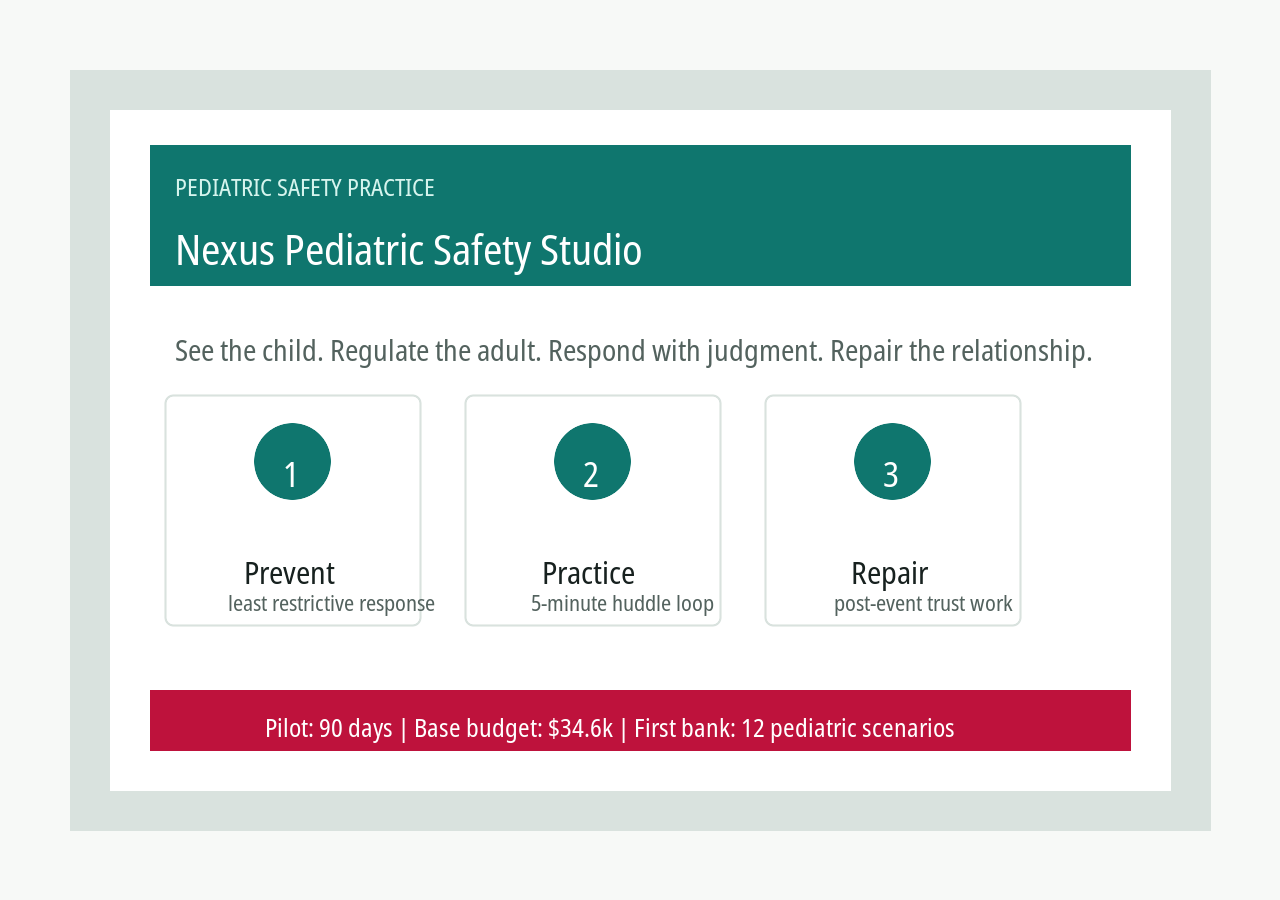
The current package includes a best-guess CPI-aligned scaffold, a full internal asset system, and an upgraded corporate PDF. It does not quote proprietary CPI materials, does not replace formal CPI or Nexus addendum training, and does not authorize clinical use.
Budget, rollout, governance, drift controls, public evidence links, and sponsor decision materials.
Provisional CPI mapping, scenario cards, facilitator training content, and clinical checklists stay marked pending Nexus/CPI validation.
Official CPI level language, Nexus restraint/seclusion policy citations, and patient-facing materials require Nexus source documents and sign-off.
This is not another huddle activity. It is a patient-safety operating system for the moments before escalation, during imminent-risk decision-making, and after rupture repair.
Scenarios include developmental stage, sensory overload, elopement risk, family at bedside, neurodevelopmental needs, and post-hold repair.
The program does not teach a blanket no-touch rule. It teaches the least restrictive effective response, with trained contact only when policy and immediate safety require it.
No prizes for right answers, no public ranking, no shame. The point is a safer next shift, not a staff trivia contest.
Name age, developmental context, trigger, and immediate safety condition.
Use freeze-frame or non-contact staging for a reasonable response that missed the clinical move.
What is the child telling us? What changes the next move?
Practice staff regulation, positioning, language, one-voice team coordination, and safety threshold.
Clarify verbal support, team support, and immediate safety intervention boundaries.
Name what happens after the child is safe, then record what landed for the team.
The review draft uses public, high-level CPI concepts only: escalation-stage thinking, matched staff response, likelihood/severity risk judgment, staff self-regulation, and therapeutic repair. Nexus must validate the exact CPI level names, addendum language, restraint/seclusion thresholds, and documentation requirements.
| Observed state | Provisional response | Pediatric review question |
|---|---|---|
| Anxiety or distress | Supportive response | What is the child communicating, and what lowers stimulation? |
| Defensive behavior or refusal | Directive response with choice where allowed | What clear limit or next step is needed without creating a power struggle? |
| Risk behavior or imminent harm | Immediate safety intervention by trained staff under policy | What is the likelihood and severity of harm if we wait? |
| Tension reduction or recovery | Therapeutic rapport and repair | What does the child need from us after the event? |
This table is deliberately provisional. It must be reviewed by the Nexus CPI/addendum lead before any facilitator uses it.
The financial decision is whether five protected minutes, repeated across the year, is worth lower preventable escalation, lower injury exposure, fewer grievance risks, and better staff confidence.
| Case | Total | Use |
|---|---|---|
| Low | $22,950 | Lean internal build |
| Base | $34,600 | Recommended pilot plan |
| High | $55,800 | More educator, compliance, and dashboard support |
Likely cash outlay: $2,000 to $8,000. Most cost is absorbed labor and protected clinical attention.
| Case | Total | Use |
|---|---|---|
| Low | $65,400 | Minimum sustainable rhythm |
| Base | $96,400 | Recommended annual program |
| High | $150,100 | Heavier education, data, governance, and refresh capacity |
Finance should replace these planning numbers with Nexus actual loaded labor rates, census, and baseline event data.
The asset pack is now published on this site for review: 54 generated files across governance, approval, validation, facilitator operations, measurement, logistics, public copy, and scenario shells. The files remain review artifacts, not clinical policy or rollout approval.
Sponsor packet, CNO/CFO memo, pilot charter, RACI, annual calendar, scale decision packet, stop criteria, and implementation runbook.
Clinical, CPI/addendum, and risk review checklists, plus a provisional CPI alignment model that must be validated before use.
Quick card, psychological safety script, no-unsafe-contact rule, QR log mock, pulse survey, dashboard spec, weekly and monthly review templates.
Confirm CPI language, Nexus addendum language, policy boundaries, documentation, stop criteria, and pilot unit.
Build the 12-scenario deck, facilitator card, log, pulse survey, and dry-run with clinical observers.
Run four sim days per week, three huddle windows per day where realistic, with weekly and monthly reviews.
Scale only if staff confidence, debrief quality, and leading safety indicators improve without punitive drift.
Each public module below is only a high-level review summary. The full scenario cards are internal validation shells and must be approved by the clinical owner before huddle use.
Elopement-vulnerable door after a difficult family visit. Teach regulated presence, side approach, door-area support, and trained contact only when imminent safety requires it.
Neurodevelopmental overwhelm in the dayroom. Teach lowering stimulation before demanding lower behavior.
A teen refuses meds and turns away. Teach choice where clinically allowed, boundary without power struggle, and return plan.
A parent raises the emotional temperature. Teach regulating the family system while protecting the child.
A child is quiet after a serious intervention. Teach repair, offer of connection, documentation, and treatment-team follow-up.
A child holds a potentially unsafe item. Teach risk assessment, no tug-of-war, exchange choices, and escalation threshold.
Peers are watching and commenting. Teach one communicator and audience management.
Thin staffing and fatigue. Teach early support, slower voice, and recognizing staff fatigue as a clinical risk.
A young child hides after a loud transition. Teach safety perimeter, time, reduced stimulation, and simple choices.
Two staff disagree in front of a child. Teach side-check, one message, and empathy without changing the limit.
Staff misread family meaning-making as noncompliance. Teach respectful clarification and appropriate support.
Refusal after discharge discussion. Teach seeing earlier triggers and giving concrete next-step structure.
Huddle sims use freeze-frame or non-contact staging unless approved instructors run a controlled training environment.
Facilitators who shame staff or distort policy lose the role. Psychological safety is part of clinical safety.
The program avoids casual "never" and "always" language around contact because real safety thresholds matter.
No. It is an executive and clinical review draft. Nexus must validate CPI language, addendum specifics, restraint/seclusion policy, DASA alignment, documentation requirements, staffing assumptions, payroll rates, and baseline metrics.
No. It reinforces judgment between formal trainings. It does not replace CPI, Nexus addendum training, restraint/seclusion policy, competency, recertification, or clinical supervision.
Corporate reviewers need to see how the operating model maps to escalation-stage thinking. The exact language remains blocked until Nexus's CPI/addendum lead approves it.
Scenario cards, facilitator scripts, clinical checklists, and measurement templates are internal operating materials. Publishing them before validation would create clinical authority the draft does not have.
Nexus must validate CPI level language, Nexus addendum specifics, restraint/seclusion policy, DASA alignment, documentation requirements, local staffing, payroll rates, and baseline safety metrics before use. Public CPI links below are used only for high-level review scaffolding.